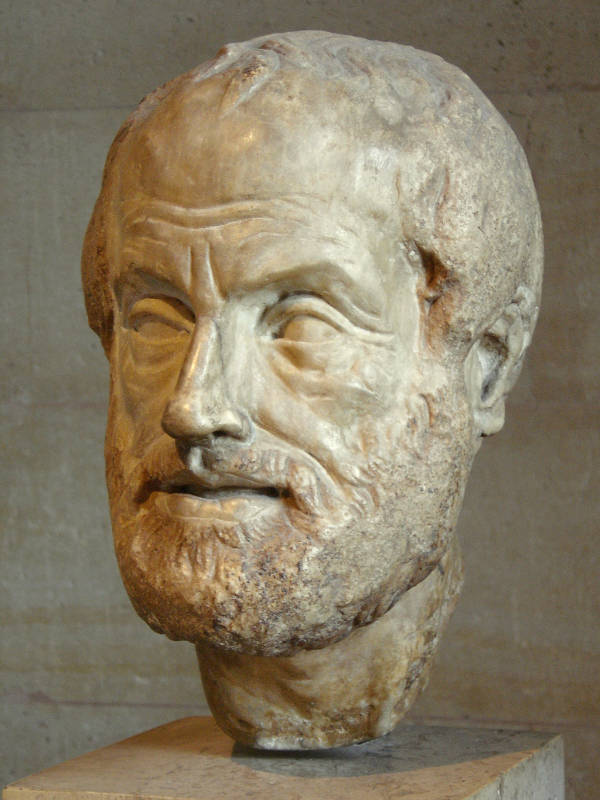
Reasoned Realism, Empirical Exploration.
The Aristotelian Tradition from 384 to 322 BCE
The Aristotelian tradition, named after the Greek philosopher Aristotle, refers to the intellectual and philosophical ideas that emerged during the period from 384 to 322 BCE. Aristotle was one of the most prominent philosophers of his time and his ideas and teachings had a profound influence on Western philosophy and thought. His work encompassed many fields, including metaphysics, ethics, politics, biology, and logic.
Aristotle was born in 384 BCE in Stagira, a small town in northern Greece. He was the son of a physician and spent much of his early life studying science and medicine. Later, he studied under the famous philosopher Plato in Athens, where he developed his own philosophical ideas and became known as one of the greatest thinkers of his time.
Aristotle's philosophy was based on observation and empirical evidence. He believed that knowledge came from experience and that the universe was made up of matter and form. He also believed that everything had a purpose or function, and that this purpose could be discovered through observation and analysis.
In his work on metaphysics, Aristotle developed the concept of causality, which stated that everything had a cause and that these causes could be understood through logical reasoning. He also argued that the universe was infinite and eternal, and that there was a prime mover or first cause that set everything in motion.
In addition to his work on metaphysics, Aristotle made significant contributions to ethics and politics. He believed that human beings had a natural inclination towards virtuous behavior and that this behavior could be cultivated through education and practice. He also argued that the best form of government was a constitutional monarchy, where power was shared between the ruler and the people.
Aristotle's work on logic was also groundbreaking. He developed a system of deductive reasoning known as syllogism, which is still used today in fields such as mathematics and computer science.
Overall, the Aristotelian tradition had a profound impact on Western thought and philosophy. Aristotle's ideas on metaphysics, ethics, politics, and logic continue to influence our understanding of the world today. His legacy can be seen in the work of many great thinkers throughout history, including Thomas Aquinas, Immanuel Kant, and Friedrich Nietzsche.
Aristotelian
Timeline
Laying the groundwork for logical reasoning.
Aristotle's Early WorksFrom 350 to 322 BCE
Pondering the nature of reality.
MetaphysicsFrom 350 to 322 BCE
Seeking the good life through virtuous living.
EthicsFrom 350 to 322 BCE
The search for the ideal political system.
PoliticsFrom 350 to 322 BCE
A centre of philosophical inquiry and scientific investigation.
The LyceumFrom 335 to 322 BCE
Carrying on the legacy of Aristotle's ideas and methods.
Peripatetic PhilosophyFrom 322 BCE to present