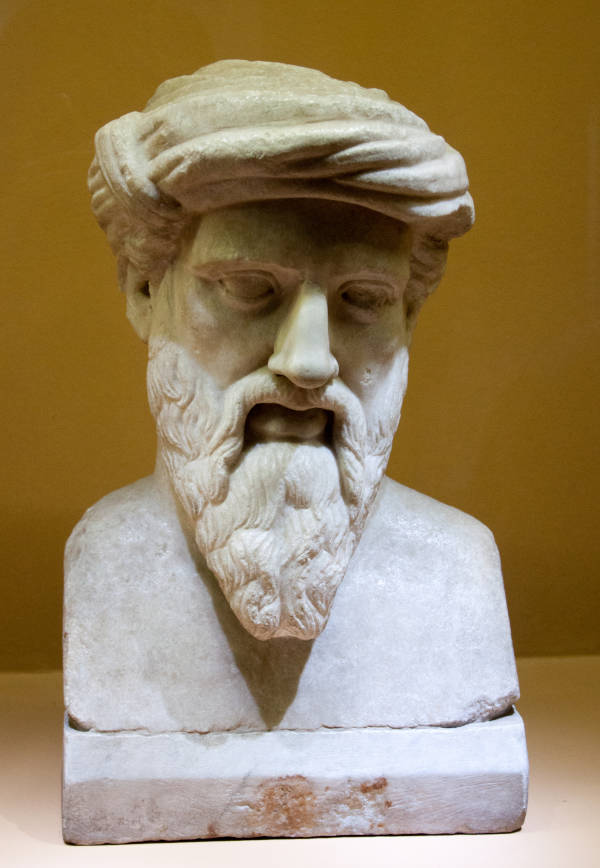
Primal Questions, Pioneering Thoughts
Pre-Socratic Philosophy from 624 to 450 BCE
Pre-Socratic philosophy refers to the period of ancient Greek philosophy that occurred before the time of Socrates. It is also known as the Presocratic period and spans from 624 to 450 BCE. During this time, philosophers sought to understand the nature of reality, the universe, and human existence through observation and rational thinking, rather than relying on myths and religious beliefs.
One of the most prominent Pre-Socratic philosophers was Thales of Miletus, who lived from 624 to 546 BCE. Thales believed that everything in the universe was made of water and that water was the primary substance from which all other things were created. His idea of a universal substance was a significant step towards a naturalistic approach to understanding the universe, as opposed to a supernatural one.
Another influential Pre-Socratic philosopher was Heraclitus of Ephesus, who lived from 535 to 475 BCE. Heraclitus believed that change was the fundamental nature of reality and that everything was in a state of flux. He is famous for saying, "No man ever steps in the same river twice." This idea of perpetual change laid the foundation for the philosophy of process and became a significant theme in later philosophical schools.
Parmenides of Elea was another important Pre-Socratic philosopher, who lived from 515 to 450 BCE. Parmenides argued that reality was one unchanging, eternal, and indivisible entity. He believed that change and movement were an illusion, and the universe was static. His ideas about the nature of being and non-being influenced later philosophers such as Plato and Aristotle.
Other notable Pre-Socratic philosophers include Anaximenes, who believed that air was the primary substance, and Empedocles, who believed that the universe was made up of four elements: earth, water, air, and fire.
Pre-Socratic philosophy played a crucial role in the development of Western thought, laying the groundwork for the subsequent philosophical movements. These philosophers sought to understand the nature of the universe and human existence through rational thinking and observation, paving the way for the scientific method. They challenged traditional religious beliefs and myths and offered new ways of looking at the world, which had a profound impact on the development of Western civilization.
Pre-Socratic
Timeline
The search for the first principle.
The Milesian Schoolfrom 624 to 545 BCE
The universe as a harmonious whole.
Pythagoreanismfrom 580 to 330 BCE
The paradoxes of being.
The Eleatic Schoolfrom 485 BCE to 380 BCE
The many and the diverse.
The Pluralist Schoolc. 450 BCE